
Surrounded by Blue.
Finding yourself floating amongst an aggregation of blue whales is like no other experience on planet Earth. This is what I encountered for the first time in the middle of July 2020. Spouts were everywhere as we sat near the western end of Santa Cruz Island in the Santa Barbara Channel. I was working as a deckhand aboard Condor Express Whale Watching, and as far as the eye could see, there were blue whales. For me, blue whales had always been at the top of my bucket list. The largest animal to exist in Earth’s 4.6 billion-year history just so happens to exist during my lifetime. This fact alone is beyond incredible. Bigger than any dinosaur, as long as 2.5 school buses, the sheer size of a blue whale is immense, only surpassed by their wicked beauty. With a shimmer as they surface on a bright sunny day, they truly are the diamonds of the sea. While taking a breath, they exhale at over 300 mph from the largest pair of nostrils on the planet: their blowholes. You see them rise from the depths, and they keep going, and going, and going, until you see a tiny dorsal fin break the surface. In many fast-moving species, like dolphins or sharks, the dorsal fin provides balance and stability, keeping the animals upright in the water column. Blue whales don’t need the same balance point, as their massive girth keeps them upright. Over time, this fin has evolved to be smaller and smaller. After the dorsal fin, a large tail stock, or peduncle, is seen before they lift their incredible tail fluke, which measures 25 feet across, the same as a small Cessna airplane. It is truly an incredible sight.

The first time I saw a blue whale was 2 years prior, in the summer of 2018. I was on a whale-watching trip as a passenger out of Newport Beach. Two Giant blues surfaced next to us; it is still ingrained in my memory to this day. Fast forward 2 years, and there I was again, in complete awe of these mighty creatures. However, this time, amongst the crowd, one whale stood out. It was traveling and surfacing with a blue whale with a familiar phenotype, but this one was different. I took another look before wiping my eyes. Was it purple? A purple blue whale? I wiped my eyes again. Indeed, it had a purplish hue to it. I was perplexed.
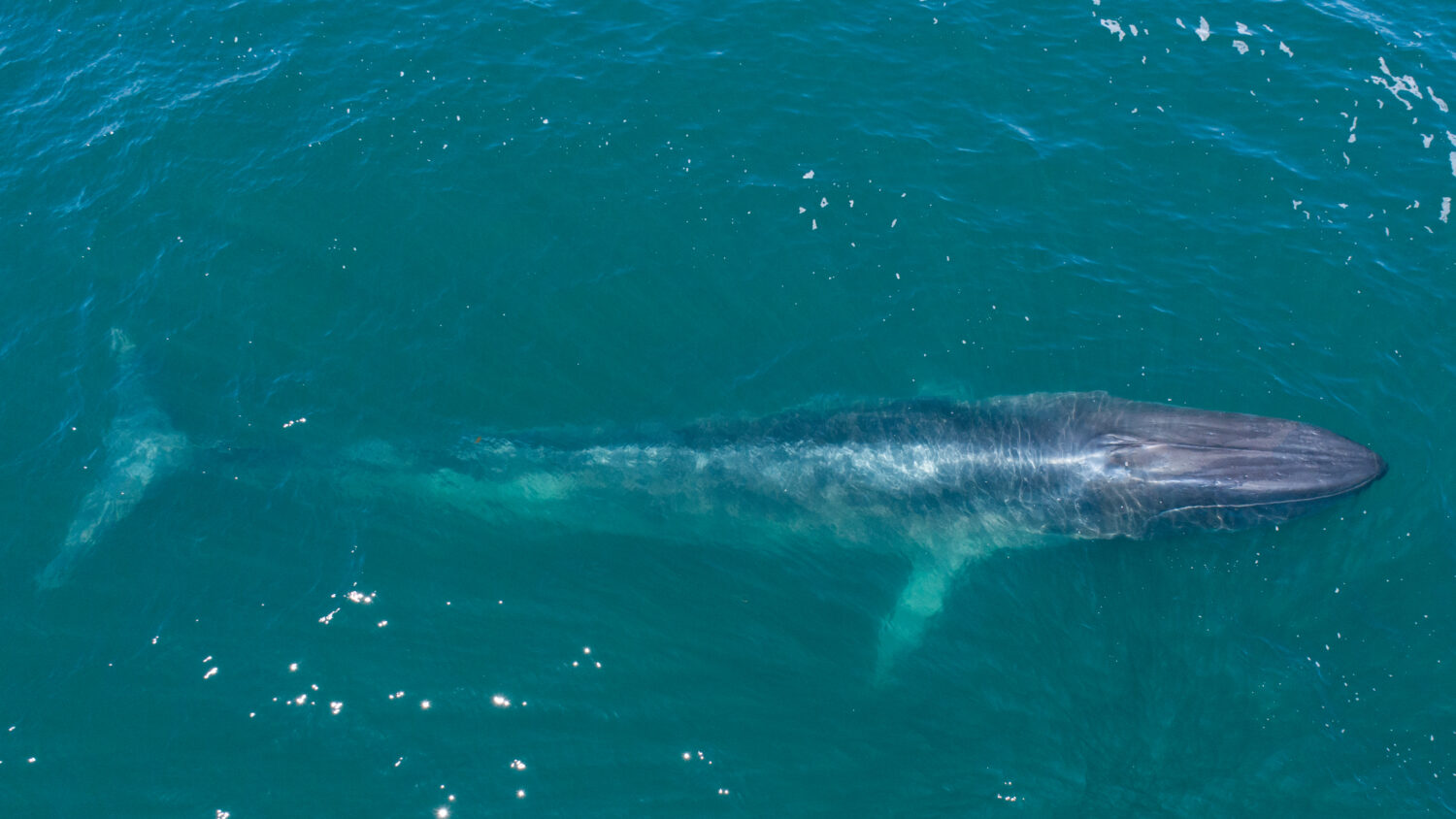
My immediate thought was a hybrid. I had no idea why this thought popped into my head, because I had never heard of a hybrid whale before. The animal simply looked like a blue whale crossed with a fin whale (the second-largest animal in the world). Upon closer inspection, and with the drone in the air, the whale had a faint chevron marking on its back, a classic sign of a fin whale, but lacked the bright white lower right jaw of a fin whale. It resembled the color of a fin whale but with an odd purple hue. Its dorsal fin was massive like a fin whale, but it had faint mottling on its back similar to a blue whale. It wasn’t until it lifted its giant tail out of the ocean that I knew it was something very odd. Fin whales don’t lift their tails like blue whales. In all my years on the ocean, I have never seen a fin whale tail fluke. I was convinced it was a hybrid whale. I collected as many drone videos and camera photos as I could, and rushed home to find out more.


Upon getting home, I reached out to legendary blue whale researcher and conservationist John Calambokidis. John founded Cascadia Research Collective, a world-leading whale research group, and has spent more time with blue whales than probably anyone on the planet. I sent him photos and videos from the day and eagerly awaited a response. *Ping* My email went off a few days later.
Not only was this whale a hybrid between a blue whale and a fin whale, but he was, in fact, the ONLY confirmed living blue whale/ fin whale living in the entire ocean, and John had met him before on numerous occasions. The first *confirmed* sighting of this whale occurred in 2004 by John and his team. It wasn’t until 11 years later that the next sighting occurred by Oregon State University. Their team was able to get a genetic sample from “Flue” using a biopsy dart: a simple yet specialized, minimally invasive tool fired from a crossbow or pneumatic rifle to collect a tiny plug of skin and blubber from a free-swimming whale. They also fitted him with a satellite tag to track his movements. These two valuable pieces of information would help us understand much more about this incredibly unique animal.
The big finding
Flue is a male hybrid whose mother was a blue whale, and father was a fin whale. Genetic analysis found approximately 68.5% fin whale and 31.5% blue whale ancestry. Mitochondrial DNA—which is inherited from the mother—identified the maternal lineage as blue whale. Even though Flue looks more like a fin whale than a blue whale at first glance, his behavior tells a different story.
Where Flue goes
Researchers documented roughly 20 sightings between 2004 and 2020, primarily in two areas:
- Summer/feeding grounds: Southern and central California, particularly around the western Channel Islands, Point Conception, San Miguel Island, and waters extending north toward Big Sur.
- Winter/breeding grounds: The Gulf of California, particularly around Loreto.
That pattern is particularly interesting because it looks much more like a blue whale migration than a fin whale migration. Eastern North Pacific blue whales migrate between productive California feeding grounds and warmer wintering/breeding areas, including the Gulf of California. Many fin whales, by comparison, show considerably more residency within their respective regions. His satellite track is especially interesting.
On July 16, 2015, researchers tagged Flue about 13 km west of San Miguel Island in the Santa Barbara Channel Whale Heritage Area. The tag transmitted for 28.1 days, during which Flue traveled at least 1,445 km. His movements were roughly:
San Miguel Island → Point Arguello → Big Sur → Davidson Seamount → Santa Lucia Bank → back toward San Miguel Island.
Rather than simply migrating north or south, he made large looping movements between productive offshore feeding areas. The waters west of San Miguel Island appear particularly important because Point Conception’s upwelling, shelf breaks, island slopes, and seamounts create conditions that concentrate krill—the primary prey of blue whales.
All of this information is outlined and highlighted in a research paper available here.
One of the rarest sights in nature, “FLUE,” the blue whale/ fin whale hybrid, speaks to the untold mystery of our great blue planet.
Adam Ernster, Wildlife Filmmaker.
This week marks 6 years since I last saw Flue in the Santa Barbara Channel Whale Heritage Area. The knowledge I’ve gained from him and the impact he’s had on me are immense. It is stories like that of Flue that remind me that there is so much we don’t know about our oceans. Our ocean holds so much wonder. If a giant 80-foot hybrid whale can go virtually undetected for years, who knows what else is out there that we have never seen before? Sanctuaries for marine wildlife like the Santa Barbara Channel Whale Heritage Area are pillars of biodiversity, housing everything from thousands upon thousands of common dolphins, endangered species like blue whales, and yes, even mysterious hybrids. These areas are sacred, not only to the health of our planet but to the culture of our species: a species forever intertwined with the great blue. These areas are what make our planet so special; they show us what’s worth fighting for.
The big question is: where is he now?
There was a confirmed sighting of Flue in the Sea of Cortez in 2023, and an unconfirmed sighting of him this year. There are many “Flue,” look-alikes out there, but many are either fin whales or blue whales with similar damage to their dorsal fin. There is only one confirmed blue whale/ fin whale hybrid in the Eastern North Pacific, and I for one, am hopeful we cross paths again in the years to come.
Adam Ernster
Wildlife Filmmaker // Media Director – SBCWHA